Quick summary / TL;DR
This guide shows how to plan and install a marine solar system for small recreational boats through cruising yachts. Key priorities: do a power audit, choose marine‑grade components, use an MPPT charge controller for most systems, install over‑current protection at the battery (per ABYC), and seal/fasten deck penetrations properly. Consult a qualified marine electrician for through‑deck work, high‑power wiring, or when local rules require a pro.
Why solar on a boat and how it works
Solar (PV) panels convert sunlight to DC power that passes through a charge controller into your battery bank and then to loads. Important terms:
- PV / photovoltaic module — the solar panel.
- Vmp / Voc / Imp / Isc — panel voltage/current at the maximum power point and open/short circuit; record these from the panel datasheet.
- MPPT (maximum power point tracking) vs PWM (pulse‑width modulation) controller — MPPT recovers substantially more energy under real conditions and is recommended for most systems; MPPT can yield roughly 10–40% higher harvest versus PWM depending on conditions.
- BMS — battery management system for LiFePO4 packs.
Step 1 — Plan before you buy
Do a simple power audit: list daily amp‑hours used by fridges, lights, instruments and add a safety margin (25–50%). Estimate available roof/deck area and shading. Rule‑of‑thumb energy: 100 W of panel in 4–5 peak sun hours produces roughly 30–45 Ah on a 12 V system (approximate — calculate from your panel wattage and local sun hours).
Step 2 — Component selection
Choose components that are marine‑rated and sized to your audit.
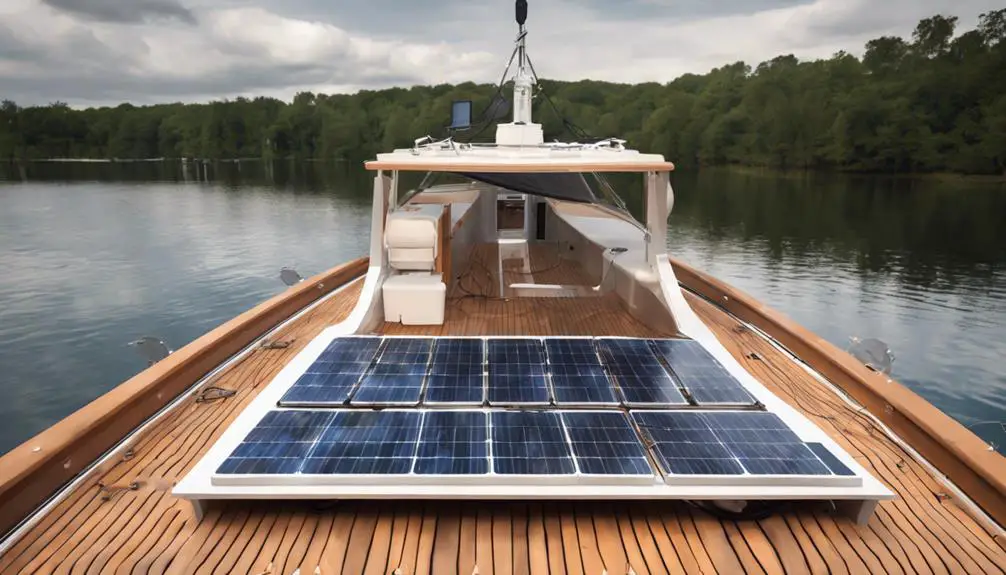
- Panels: rigid framed monocrystalline panels are highest efficiency and longest lasting; semi‑flexible panels save weight and conform to curves but typically have shorter lifetimes and higher delamination risk. Walk‑on panels are available where deck traffic is required.
- Charge controller: prefer MPPT for systems larger than a small trickle charger or where panel voltage doesn’t match battery voltage. MPPT controllers are especially useful for LiFePO4 banks.
- Batteries: AGM may be simpler to set up; LiFePO4 (lithium‑iron‑phosphate) offers lower weight, higher usable capacity and longer life but requires correct charge profiles and a BMS. Always follow the battery manufacturer’s recommended charge voltages and temperature cut‑offs.
- Wiring & connectors: use tinned, fine‑stranded marine cable (UV and salt‑spray resistant), marine‑rated MC4/IP67 connectors, and appropriately sized AWG for run length and current. Low‑quality household wiring and connectors are not suitable.
- Hardware: use 316 or 316L stainless steel for deck fasteners and rails exposed to salt and vibration.
Step 3 — Mechanical mounting & sealant practice
Choose a mounting method that matches your hull/coachroof construction. Use backing plates under through‑deck screws for load distribution. For bedding/sealant, use a serviceable marine sealant (e.g., equivalent to 3M 4200) where you may need to remove hardware later; reserve permanent structural sealants (e.g., equivalent to 3M 5200) only where permanent joints are intended. Protect cable entries with proper glands and backing.
Step 4 — Electrical wiring & protection
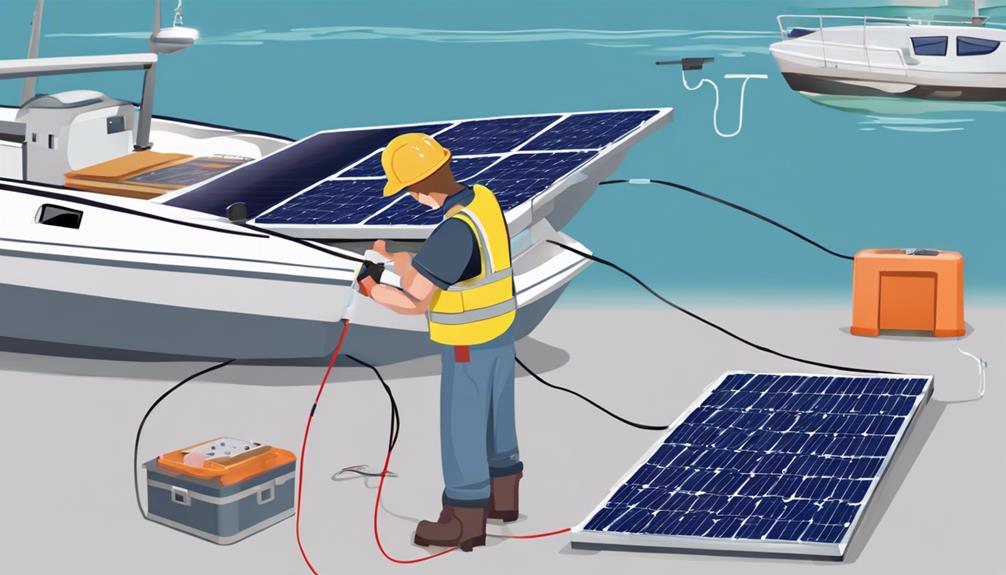
Route PV cables to the charge controller with minimal sharp bends and protected from chafe. Install over‑current protection/fuses in the battery positive lead as required by marine practice and ABYC E‑11 — the fuse must be positioned very near the battery terminal. Use combiner boxes or appropriately rated parallel connectors for multiple panels and keep MC4 connections secure and dry. Provide a DC disconnect and label circuits; for high‑power systems consider surge protection and a master switch per your electrical code.
Step 5 — Commissioning & configuration
- Before connecting: verify panel Voc and controller input limits, check polarity, and confirm wire/fuse sizing.
- Set the MPPT to the battery chemistry and the manufacturer’s recommended charge profile (float/absorb/setpoints). For LiFePO4, ensure MPPT or the battery charger respects the battery maker’s voltage limits and temperature cut‑outs and that a BMS is installed.
- After first connection: monitor voltage, charge current and battery temperature for several days to confirm expected behavior and energy harvest.
Operation & maintenance
Inspect fasteners and seals annually and after heavy weather; clean panels with fresh water, check MC4 connectors for corrosion or looseness, and look for panel delamination (especially on flexible modules). Retorque hardware per manufacturer specs and monitor battery state‑of‑charge regularly.
Safety, codes & when to hire a professional
This article is informational only. Follow ABYC and local electrical codes and verify details with the battery and controller manuals. Hire a qualified marine electrician for through‑deck penetrations, any work with high currents (>30 A), complex battery integration, or when your insurance/local laws require professional sign‑off.
Further reading / official references
- ABYC electrical standards (E‑11) for over‑current protection and wiring practice.
- Manufacturer manuals for your chosen MPPT and batteries (for charge profiles and limits).
- Marine wiring primers on tinned cable, marine hardware guides (316 stainless), and marine sealant selection resources.
Last updated: 2026‑06‑19. Verify final specifications with manufacturer datasheets and a qualified marine electrician before starting work.