Updated June 20, 2026.
TL;DR: For limited roof space choose high-efficiency monocrystalline modules; for occasional boondocking use portable/foldable panels; for curved or low-profile roofs use flexible panels. Size panels to match daily Wh needs and prefer MPPT charge controllers with a proper BMS and LiFePO4 battery if you plan deep cycling.
Why caravan solar systems differ from home arrays
Caravan and RV solar systems face unique constraints: very limited roof area, low tilt (flat on the roof), vibration and movement, and tighter weight limits. You’ll also often face partial shade from awnings or trees and variable sunlight while driving or parked. These factors change the way you choose modules and system components compared with a house installation.
Quick takeaways
- Pick high-efficiency monocrystalline panels when roof space is tight — modern mainstream modules commonly fall in the ~19–25% efficiency range (Fraunhofer ISE).
- Use MPPT charge controllers for most 12 V/24 V caravan banks — they commonly harvest 15–30% more energy vs PWM in many conditions (Victron).
- Verify module certifications and fire/safety ratings; UL/IEC standards have been updated (look for current IEC/UL markings) (UL).
Panel types and modern cell tech (short guide)
Know the common terms when comparing panels:
- Monocrystalline: Highest power density and best for limited roof space; often PERC, half-cut, TOPCon or HJT cell variants.
- Polycrystalline / multicrystalline: Less common in current high-efficiency caravan panels — lower W/m² vs modern mono.
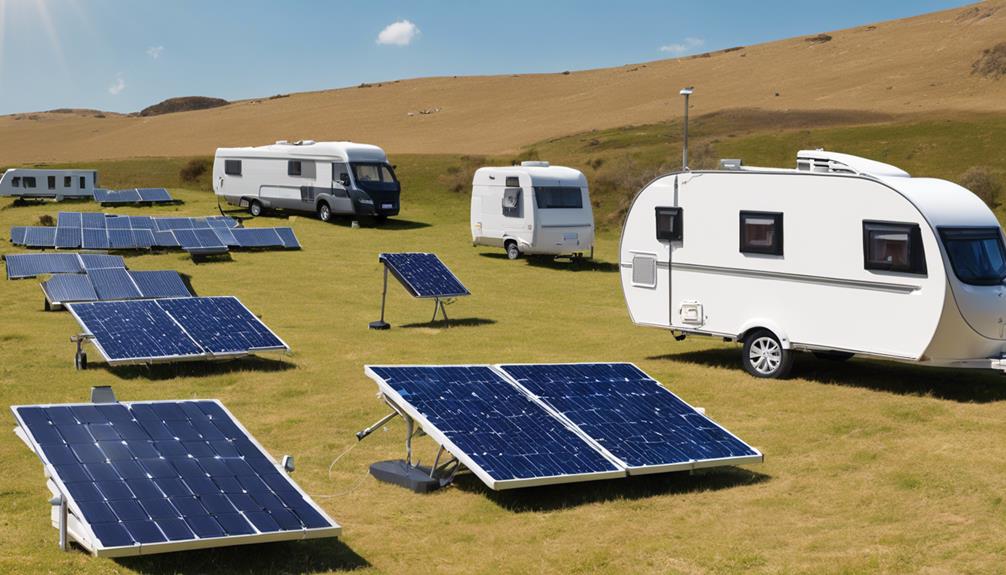
- Flexible/foldable: Lightweight or packable options for curved roofs or temporary setups; usually lower efficiency and shorter warranties.
- Thin-film: Low weight and flexible but much lower efficiency — niche use only.
Advanced cell tech terms: PERC, half-cut cells, TOPCon, and HJT can improve output and shade response; bifacial/tandem are less common on RV-focused products.
Panel category comparison
| Category | Typical W range | Efficiency range | Pros | Cons | Typical warranties |
|---|---|---|---|---|---|
| Rooftop fixed | 100–400 W per panel | 18–25% | Highest W/m², durable tempered glass, long warranties | Heavier; needs strong mounting | 5–25 years |
| Flexible | 50–200 W | 12–18% | Conforms to curved roofs, low profile, lightweight | Lower output, shorter life, limited warranty | 1–10 years |
| Foldable / Portable | 50–200 W | 15–21% | Portable, set up away from shade, useful as supplemental | Bulky to carry, lower watts per area, variable durability | 1–10 years |
Example portable/foldable product ranges and specs are widely available from makers such as Goal Zero for small 50–200 W kits (example).
Sizing & simple power math
Start with your daily Wh (watt-hours) consumption: lights, fridge, pump, phone charging. Then divide by expected average sun-hours (site-specific) and add a margin for inefficiency (system losses, poor angle, shade).
Two quick examples (conservative assumptions; adjust for location & season):
- Weekend camping: lights + small fridge ≈ 200–400 Wh/day → ~100–200 W of panels (nominal) assuming 3–5 effective sun-hours.
- Full-time boondocking: 12 V fridge + electronics ≈ 1,500–2,500 Wh/day → 400–800 W rooftop array plus 200–400 Ah LiFePO4 battery bank (site and climate dependent).
These examples are illustrative — exact output depends on location, tilt, temperature, and shading.
Essential system components
- Charge controller: MPPT preferred for most caravan setups — better harvest, especially in low light or when panel Vmp ≠ battery voltage (Victron).
- Batteries: LiFePO4 for long life, depth-of-discharge and weight advantages; AGM/lead-acid only for low-cost short-term use. Use a proper BMS.
- Inverter/DC-DC converter: Size to peak loads; prefer pure-sine for sensitive electronics.
- Safety: Proper fusing, correct gauge wiring, surge protection and certified connectors.
Durability & certification checklist
Look for tempered glass, corrosion-resistant frames, IP ratings for junction boxes, and current IEC/UL markings — UL standards moved toward the UL 61730/IEC 61730 series, so verify labelling before purchase (UL).
How we test / evaluate (if reviews are added)
We recommend evaluating modules by: real-world energy output (portable test on an RV roof), spec verification (Wp, Vmp/Voc, NOCT), certifications, warranty terms, weight and wind/vibration mounting tests, and long-term durability checks.
Buyer checklist (pre-purchase)
- Calculate daily Wh and roof usable area
- Prefer monocrystalline high-efficiency panels if space limited
- Choose MPPT controller sized to panel Voc/Vmp and battery bank
- Confirm IEC/UL certifications and warranty terms
- Plan mounting, wiring run lengths, fusing and ventilation
- Match battery chemistry (LiFePO4 recommended for frequent deep cycles)
Common FAQs
Q: Do I need MPPT? A: For most caravan systems yes — MPPT improves harvest in partial shade and low light; PWM is only acceptable for tiny single-panel setups (Victron).
Q: Are flexible panels durable? A: Flexible panels are lighter and fit curved roofs but typically have lower output, shorter warranties and can degrade faster than glass panels.
Q: How many watts do I need? A: Size by Wh/day and sun-hours. Use conservative local insolation figures and include system losses.
Q: Should I get LiFePO4? A: For frequent boondocking, yes — longer life, lighter weight and better usable capacity than AGM.
Market cost context: while residential system prices have trended down (median U.S. installed price context available from EnergySage), caravan components and portable panels follow different price structures — evaluate cost-per-watt plus weight and warranty rather than headline price alone (EnergySage).
Want a practical next step? Download a caravan solar sizing checklist and compare top choices by the criteria above before buying.
Sources: Fraunhofer ISE Photovoltaics Report; Victron Energy MPPT vs PWM guide; UL updates on PV module standards; Goal Zero product specs; EnergySage market reports.