Quick answer: For a year‑round fixed array, set the panel tilt close to your site latitude (or use the refined rule 0.76×latitude + 3.1°) and face panels toward true south in the Northern Hemisphere (true north for the Southern Hemisphere). Don’t optimize for one day (like March 21); model your site with PVWatts or PVGIS to capture shading and weather. (See PVWatts and NOAA Solar Calculator in the resources below.)
How the Sun moves — the basics you need
Understanding a few terms makes tilt and orientation intuitive:
- Solar azimuth: compass direction a panel faces (degrees clockwise from true North; 180° = true south).
- Tilt (elevation) angle: panel slope measured up from horizontal (degrees).
- Solar noon: the moment the Sun crosses your local meridian and reaches its highest altitude that day (not always clock 12:00). See the NOAA solar calculator for exact times.
- Solar declination: the Sun’s seasonal angular offset from the celestial equator (what makes summer and winter sun paths different).
Visual (recommended): three sun‑path curves showing winter solstice, equinox (about March 20–21), and summer solstice for a mid‑latitude site. Alt text: “Sun paths at winter solstice, equinox, summer solstice from 40°N.” Caption: “Sun paths vary by season — a fixed tilt is a compromise over the whole year.”
Practical rules for fixed panels
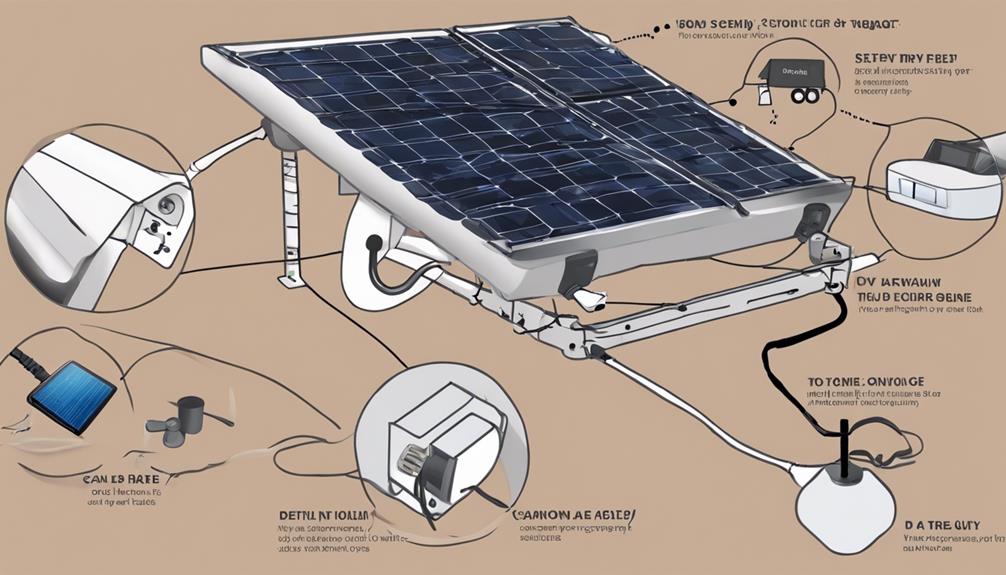
- Latitude rule (simple): set fixed tilt ≈ site latitude. This is a widely used baseline because it balances seasonal performance for annual energy (NREL).
- Refined empirical formula (better): optimal fixed tilt ≈ 0.76 × latitude + 3.1°. This small adjustment often yields modest additional annual yield at many mid‑latitude sites (industry/empirical sources).
- Seasonal tweaks if you can adjust tilt: for summer use roughly latitude − 10–15°, for winter latitude + 10–15°, or change tilt twice a year (spring/winter) for modest extra gains. Expect only a few percent annual improvement versus a good fixed tilt.
- Sample (latitude 40°N): simple latitude rule → 40° tilt; refined rule → 0.76×40 + 3.1 = 33.5° tilt.
Sources: NREL guidance and industry tilt calculators (see resources).
Azimuth and orientation: how far off is OK?
In the Northern Hemisphere, true south (solar azimuth ≈ 180°) maximizes annual yield. Arrays tolerate moderate azimuth deviations: small offsets (±20°–45°) only modestly reduce annual kWh. If your roof faces east or west, consider splitting an array between east and west faces or accepting a small loss — time‑of‑use electricity pricing can make east/west installations economically attractive because they shift output to morning or afternoon when rates are higher.
Solar noon, time zones, and the March 21 myth
People sometimes say “point panels at the Sun at 12:00 on March 21 (the equinox).” That’s misleading. The equinox is a useful illustration of the Sun’s path but optimizing for one day wastes energy across the rest of the year.
Two corrections matter when you think about solar noon and “clock time”: (1) your longitude offset from the time‑zone meridian (≈ 4 minutes per degree of longitude), and (2) the equation of time, a seasonal correction up to ±16 minutes. Use the NOAA Solar Calculator or timeanddate to get the exact value for your site and date.
Worked example (approximate): suppose you’re at longitude 74°W in the U.S. Eastern time zone (zone meridian 75°W). Longitude offset = (74 − 75)° × 4 min/° = +4 minutes (you are 1° east, so solar noon is about 4 minutes earlier than the zone meridian). On the spring equinox the equation of time is roughly a few minutes (use NOAA for the precise number for that year). If the equation of time on that date is approximately −8 minutes, then solar noon ≈ 12:00 − 4 min − 8 min ≈ 11:48 local clock time (approximate — check NOAA for exact values and daylight‑saving effects).
Bottom line: clock noon is rarely solar noon; use true solar time or an online calculator for precise sun‑position illustrations.
When to adjust tilt vs install tracking
- Two‑position seasonal adjustment (manual or motorized) gives small gains (few percent) over a year compared with a well‑chosen fixed tilt.
- Single‑axis tracking yields larger gains (often 15–30% depending on latitude and climate); dual‑axis tracking yields more but costs and maintenance are higher. Trackers are more common for ground‑mounted commercial systems than rooftop residential installations (NREL).
- Consider cost, maintenance, wind loading, and roof constraints before choosing trackers.
Local factors that matter more than a few degrees of tilt
- Shading (trees, chimneys) can cut production far more than a few degrees of tilt.
- Roof orientation and usable area often dictate array layout more than ideal tilt.
- Soiling, snow shedding, module temperature coefficients, and local cloudiness strongly influence real output.
Use modeling (NREL PVWatts, PVGIS) or a site survey to quantify these effects.
When to call a pro
If you have complex shading, structural questions, permitting or wind/snow load concerns, or want a grid‑interactive design for time‑of‑use rates, call a qualified installer or designer for a site survey and energy modeling.
Resources (quick links)
- PVWatts (NREL) — easy annual energy estimates and tilt/azimuth inputs.
- NOAA Solar Calculator — sun position and solar noon times.
- PVGIS — European/global PV modeling with tilt/azimuth options.
- Tilt calculators (industry tools) — plug in latitude for seasonal recommendations.
Conclusion — next steps
Measure your roof azimuth (compass pointing to true south), look up your latitude, and calculate two candidate fixed tilts: latitude and 0.76×latitude + 3.1°. Then run a PVWatts or PVGIS model with your local weather, shading profile, and tilt/azimuth to compare expected annual and seasonal output. If shading or structural issues are present, schedule a professional site survey.
Illustration brief (recommended assets): 1) Sun‑path diagram (SVG) — alt text: “Sun paths at winter solstice, equinox, summer solstice from 40°N”; caption: “Seasonal sun paths show why a fixed tilt is a compromise.” 2) Tilt‑by‑latitude chart (PNG/SVG) — alt text: “Recommended fixed tilt vs latitude with refined formula”; caption: “Latitude or 0.76×latitude + 3.1° are practical fixed‑tilt rules.” 3) Time‑zone/solar‑noon diagram (SVG) — alt text: “Longitude offset and equation of time shift solar noon vs clock time”; caption: “Solar noon differs from clock noon because of longitude and the equation of time.”
Sources: NREL (PVWatts / siting guidance), NOAA solar calculator, industry tilt calculators (empirical 0.76×latitude + 3.1°), and practical tilt/azimuth guides. Use PVWatts or PVGIS to model your specific site before final decisions.